Showing posts with label Construction. Show all posts

Retaining Walls – Types, Design, Stability

Retaining walls may be defined as a wall built to resist the pressure of liquid, earth filling, sand, or other granular material filled behind it after it is built. It is commonly required in the construction of hill roads, masonry dams, abutments and wingwalls of bridges and so on. Depending upon the site conditions, type of material to be retained and the height of the wall to be constructed, retaining wall may be built in dry Stone masonry, stone masonry, brick masonry, plain cement concrete and reinforced cement concrete.
Types of Retaining Walls:
Some of the types of Retaining Walls are,
  1. Gravity Retaining walls
  2. Cantilever Walls
  3. Counterfort walls
  4. Buttress Walls

Dry Stone Retaining Walls:
This is the simplest form of retaining wall. The stability of such walls depends upon the arrangement of stones in the wall and the friction between the individual stones. The stones used in the wall should be of large size and roughly hammer-dressed so as to ensure maximum bedding area. The wall should have a minimum top width of 60 cm. and the front face should have a batter varying from 1 in 4 to 1 in 3. The batter of I in 4 is adopted for walls lesser than 4.5 m in height. In principle, the height of dry stone masonry wall should be restricted to 6 m. For walls above 4.5 m in height, the upper 4.5 m of the walls is usually built of dry rubble stone masonry and the portion below this height is built with mortar.
The stones used in the wall construction are laid at right angle to the face baller. A proper bond is maintained and the front and the rear faces of the wall are nicely bonded with the hearting. The filling immediately behind the wall should consist of stone chips gravel or similar granular material and not earth. 75 to 100 mm. square weep-holes should be provided in the wall at 2m c/c vertically and horizontally to drain off the water from the filling behind. The wall has been shown in figure 943 on page (252).
Dry Stone Pitching or Revetment:
It is generally provided to protect the slopping face of an earthen cutting or embankment from erosion. Stones used, should be perfectly sound and roughly cut to fit in the shape of the pitching. In case of channels and dams, pitching should be carried at least 90 cm. above the high flood level and to ensure its stability, the toe should be prevented from slipping by suitable construction. The slopes of embankment should not be steeper than 1:1, a slope of 1½ : 1 being usually adopted. The thickness of pitching varies from 30 cm. to 75 cm. Selected stones are tightly hand packed and all the interstices are filled up with smaller pieces of stone and wedged up tight. Every stone in pitching is laid flat and no projecting stones are allowed.

Concrete Curing Methods – Curing of Concrete

What is Curing:
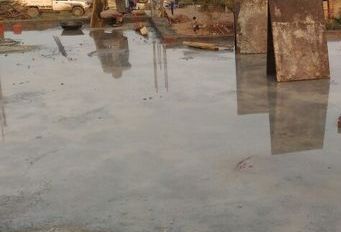
It may be defined as the operation of keeping a freshly placed concrete moist during a specified period after its finishing to ensure complete hydration of cement particles or other cementing material for obtaining a properly hardened concrete.
The concrete starts attaining its strength immediately after its setting is completed, and it continues to gain strength thereafter along with time. About 90% of concrete strength is attained in the first 28 days and its value is generally known ad design strength. Development of the concrete strength is primarily due to hydration of cement which takes place only in the presence of water. It is therefore necessary that water in the capillaries in prevented from evaporating. For proper hydration of cement particles in a freshly placed and compacted concrete, a proper environment of humidity and temperature needs be maintained. This process is called ‘curing’
Curing of Concrete

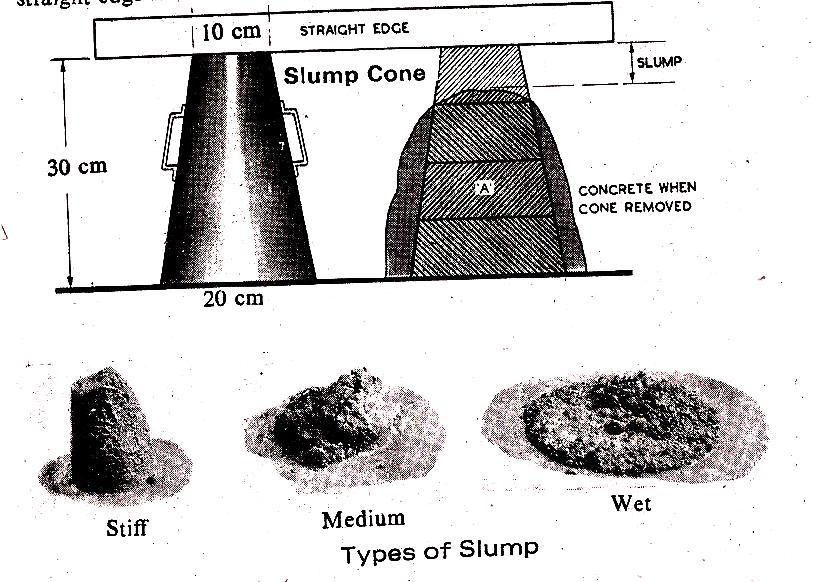
Slump Cone Test and its Advantages and Limitations

Although, the slump cone test is not entirely satisfactory since it gives widely varying results and also does not give a true measure of workability but it is of value in the field as a control test and is useful in comparing the consistence of successive batches of concrete made with the same ingredients and is one of the simplest tests to carry out. Provided no change is made in the aggregate or its grading, slump cone tests will indicate whether correct water and cement contents are being maintained. For a given slump and aggregate grading, the water required for unit volume of concrete is constant irrespective of the change of cement content. The amount of slump depends not only on the amount of water in the mix but also on the nature of the aggregate ; rounded stones give a greater slump than angular stones for the same mixture.
Slump Cone Test

HOW HOT & COLD WEATHER CAN AFFECT CONCRETE?


Effect of hot and cold weather on concrete
Concrete is not recommended to be placed at a temperature above 400C and below 50C without proper precaution as laid down in IS: 7861 (Part-1 or part-2 as the case may be).
IS:7861 part-1 deals with hot weather concreting and Part-2 deals with cold weather concreting.

Hot Weather Concreting

Special problems are encountered in the preparation, placement and curing of concrete in hot weather. High temperatures result in rapid hydration of cement, increased evaporation of-mixing water, greater mixing water demand, and large volume changes resulting in cracks. The problems of hot weather on concrete are further aggravated by a number of factors, such as use of rapid-hardening cements, handling of larger batches of concrete, etc.
Any operation of concreting done at atmospheric temperature above 400C may be put under hot weather concreting. In the absence of special precautions as laid down under IS: 7861 (Part-1), the effect of hot weather may be as follows:

A) Accelerated Setting

A higher temperature of fresh concrete results in a more rapid hydration of cement and leads to reduced workability/ accelerated setting. This reduces the handling time of concrete.

B) Reduction in Strength

Concrete mixed, placed and cured at higher temperature normally develops higher early strength than concrete produced and cured at normal temperature but at 28 days or later the strength are generally lower.

C) Increased Tendency to Crack

Rapid evaporation may cause plastic shrinkage and cracking and subsequent cooling of hardened concrete would introduce tensile stresses.

D) Rapid Evaporation of Water During Curing Period

It is difficult to retain moisture for hydration and maintain reasonably uniform temperature conditions during the curing period.

E) Difficulty in Control of Air Content in Air-Entrained Concrete

It is more difficult to control air content in air-entrained concrete. This adds to the difficulty of controlling workability. For a given amount of air-entraining agent, hot concrete will entrain less air than concrete at normal temperatures.
In order to avoid harmful effect of hot weather concreting IS: 7861 (Pt.1) recommends that temperature of ingredients should be controlled so that the temperature of produced concrete is lower. Mixing water has the greatest effect on lowering of temperature of concrete. The use of chilled water/ flaked ice in mixing produces adequate reduction in concrete temperature.
In order to control the temperature of concrete and to avoid adverse effect of hot weather, it is desirable to limit the maximum temperature of concrete as 350C to keep margin for increase in temperature during transit.
Click Read More for Cold weather Concreting

Precast Concrete Piles – Advantages & Disadvantages

Precast concrete piles are cast, cured and stored in a yard before they are installed in the field mostly by driving.

Advantages of Precast Concrete Piles
  1. Reinforcement used in the pile is not liable to change its place or get disturbed
  1. The defects in pile can be easily identified after the removal of forms, and these defects (such as presence of cavity or hole) can be repaired before driving the pile.
  1. The cost of manufacturing will be less, as a large number of piles are manufactured at a time.
  1. Precast concrete piles can be driven under water. If the subsoil water contains more sulphates, the concrete of cast in situ piles would not set. Thus precast concrete piles have added advantage in such a circumstance.
  1. Precast concrete piles are highly resistant to biological and chemical actions of the sub soil.
  1. Better quality control can be implemented as compared to bored cast in situ piles.
  1. These piles can be constructed in various cross-sectional shapes such as circular, octagonal or square.

Shotcrete and Gunite Difference

Gunite

The guniting is the most effective process of repairing concrete work which has been damaged due to inferior work or other reasons. It is also used for providing an impervious layer.The gunite is a mixture of cement and sand, the usual proportion being 1:3. A cement gun is used to deposit this mixture on the concrete surface under a pressure of about 20 to 30 N/cm2.


Top Construction Companies in India


Construction World, the largest circulated construction business magazine in India, annually organizes Construction World Awards, Construction World Annual Awards meticulously rank India's fastest growing construction companies, construction equipment manufacturing companies and construction material manufacturing companies on several criteria like growth, turnover and profitability. The results have been a landmark document on the country's construction sector, ranking the building blocks of modern India.


Fastest Growing construction Companies in India

                       
    • Ramky Infrastructure
    • Jaiprakash Associates
    • Soma Enterprises
    • Supreme Infrastructure India
    • Marg Ltd
    • MBL Infrastructure   
    • Pratibha Industries
    • Technofab Engineering
    • RPP Infra Projects
    • J Kumar Infraprojects
    • Larsen & Toubro   


Fastest Growing Construction Equipment Companies in India

                       
    • Action Construction Equipment
    • Gujarat Apollo
    • Tractors India
    • JCB India
    • L&T-komatsu Ltd
    • Sandvik
    • Elgi Equipment
    • Mcnally Bharat Engg Co
    • Sanghvi Movers   
    • Kirloskar Pneumatic
    • Elecon Engineering Co
    • Cummins India
    • Kirloskar Oil
    • KSB Pumps
    • Voltas
    • Anupam Industries
    • Atlas Copco   
   

WHAT IS SHOTCRETE?


INTRODUCTION TO SHOTCRETE OR SPRAYED CONCRETE
Shotcrete or gunite was invented by Mr. Carl Ethan Akeley (1864-1926) in 1910. For attractions of a park, this American Architect was mandated to realize in concrete the reproduction of a dinosaur. Considering the sizes of the structure, he had the idea to develop a “cement gun” machine allowing the spraying of a cementitious mortar. Shotcrete was created!
Probably a symbolic coincidence, but the same year, Mr. Kaspar Winkler founded Sika. Since that time Sika has greatly contributed to the development of the shotcrete technology. By shotcrete technology development, we mean the continuous development of chemical
additives and admixtures for shotcrete and as well the development of spraying equipments.
SHOTCRETE


FIELDS OF SHOTCRETE APPLICATION
Shotcrete is mainly used in Underground construction projects as preliminary or permanent structural support. By Underground constructions, we mean the construction of structures like road-rail tunnel, hydropower plant, mines, parking, subway, metro, storage area etc.
However shotcrete is as well as an economical tool to realize stabilization work (slope), swimming pools, waterways, concrete repairs, inner lining and architectural structures. About 90% of the shotcrete applied goes into Underground construction projects. Total volume of shotcrete worldwide applied yearly is more than 12 millions cubic meters.